The Price of Time Is a Fact. Zero Is a Lie.
Few subjects in economics generate more heat with less light than interest. The debate over what lenders may charge, whether interest is exploitation, and whether low rates are a kindness to the working man is as old as Babylon and as current as this morning’s feed. But almost none of it is conducted with any reference to economic history or to the philosophical tradition that actually defined the terms. It runs on sentiment — the creditor as villain, the debtor as victim, low rates as mercy — and sentiment, however sincere, is not an argument. The result is a set of confident falsehoods that now shape policy, and the falsehoods are doing real damage to the people they claim to protect.
This essay is an attempt to put the history and the logic back. It argues that interest is a price carrying information; that a rate suppressed by policy is a false statement about reality; that the greatest victims of that falsehood are savers, who are no longer the rich but the pensioned working class; and that the word “usury,” properly understood, condemns the suppressors and not the lenders.
Five thousand years
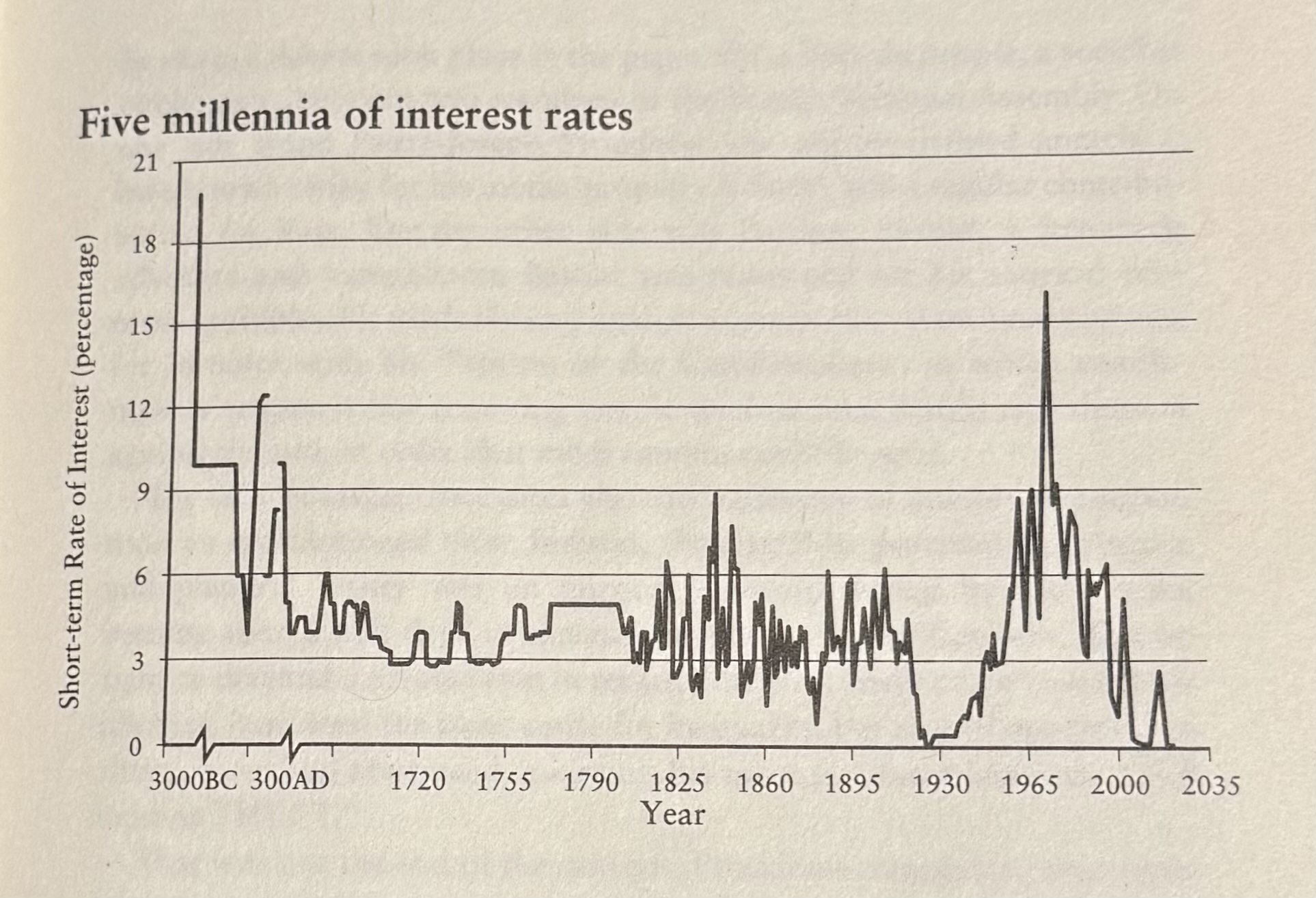
The chart above is five thousand years of interest rates, from Sumerian barley loans to the present, compiled by Sidney Homer and Richard Sylla and reprinted at the front of Edward Chancellor’s The Price of Time. Read it right to left. Babylon, Athens, Rome, the Italian city-states, the Dutch, the Victorians — the rate rises and falls with war and peace and the discovery of silver, but it never touches the floor. Then look at the last fifteen years. The lowest nominal rates in the recorded history of lending, held there deliberately, by policy, in the most financially sophisticated economy ever built.
The people who cheered that on believe they were being moral. They had it backwards.
What interest is
Interest is a price. Specifically, it’s the price of time: what it costs to persuade someone to give up consuming now so that someone else can build or consume now. Present goods are worth more than future goods — not as a cultural preference but as a condition of acting at all, since every action trades a present state for a hoped-for future one. The premium at which present and future goods exchange is interest. It would exist in a world with no banks, no money, and no lenders.
That makes it the most important piece of information in an economy. Every builder, borrower, and saver reads it to learn how scarce real savings are and how long they can afford to wait. A high rate says savings are scarce; wait, or build only what pays quickly. A low rate says savings are abundant; the long project can be financed. When the rate is discovered in a market, it carries true information, whatever its level. When it is set by an authority, it carries whatever the authority wants it to say.
So the ethical question about interest is not “how much is too much.” It is “is the price true.”
Why zero is a lie
A rate set administratively at zero is a false statement about reality, issued by an authority, that people act on. That is the definition of a lie, and I mean it in the literal rather than rhetorical sense. It tells every borrower that savings are abundant and time is free. Neither is true. And the damage from a lie is not measured by who told it but by who acted on it.
A developer models a project. At 8% it doesn’t pencil. At 3% it does. He builds. If the 3% reflected real savings, he was right to build. If it reflected a policy decision, the project was built on a false premise and fails when the price of time reverts to the truth — not because he was reckless, but because he was misinformed. The same holds for the household carrying eight loans at 0%. Each one told them the cost of pulling the future into the present was nothing. They are not living their actual risk, because they were never shown it.
Run this through the business world for fifteen years and you get what we have. Companies that exist only because debt was free. Buybacks financed at 2% to lift equity compensation. Startups that never had to find a paying customer. Leveraged roll-ups that only worked in a world that no longer exists. Most of the people who ran these businesses still do not know they were operating on a falsified price, and many of them are about to find out.
2008 is the case study, properly stated. The funds rate was held at 1% through 2003 and 2004 and well below any plausible market rate for roughly three years — a lie about the price of time. Layered on top was the federal guarantee on agency mortgages, which falsified the price of risk. Two false signals, one housing stock built on both. Rates had already risen to 5.25% by the time it broke, which is the point: the damage was done when the decisions were made, not when the bill arrived.
The clearest case: student lending
One subsidized, fixed rate for every degree, every school, every borrower. An engineering degree at a top program and a credential with a negative lifetime return are priced as identical risks. That is a government telling eighteen-year-olds that all futures pay off equally. It is false, and they bet their lives on it.
The result is what a lie about risk always produces. Tuition rose faster than almost anything else in the economy — William Bennett warned in 1987 that federal aid would simply be captured by price, and it was. Roughly half of graduates work in jobs that never required the degree. The bottom quartile would have been better off never enrolling and is still carrying the debt into middle age. The total is well over a trillion dollars of malinvestment, and the political class’s only answer is forgiveness, which moves the lie onto the taxpayer and changes nothing upstream.
The fix was never forgiveness. The fix was to let the rate float — to let the price of time tell the truth about each program and each school. The engineering student borrows at 3%; the negative-return program borrows at 15% or not at all. That sounds harsh until you compare it to the alternative, which is telling a student “go ahead” at 5% and letting the labor market deliver the real verdict a decade later. A market rate says “don’t” before the signature. That is what it is for. We turned it off and called it access.
Who the creditor is now
Mises observed in Human Action that public opinion still pictures the creditor as the idle rich and the debtor as the industrious poor, and that this picture is two centuries out of date. In the age of bonds, savings banks, insurance, and pension funds, the masses of people with moderate incomes are themselves the creditors, and the rich — as owners of leveraged companies, farms, and real estate — are more often the debtors. In asking for the expropriation of creditors, Mises wrote, the masses are unwittingly attacking their own interests.
That was 1949. It is far more true now. The creditor today is the teacher, the firefighter, the electrician, the nurse, the county clerk — anyone with a defined-benefit pension or a 401(k), which is to say most of the working population. Their retirement is a claim on future income from capital. The rate of interest is the rate at which that capital compounds. Suppress the rate and you suppress the compounding, and the person who pays is not a banker. It is the person the policy was advertised to help.
Cutting off the nose
Here the error compounds into something close to self-mutilation. A defined-benefit pension is a promise to pay a stream of income decades from now, funded by contributions today that must grow to meet it. The growth comes from returns on bonds and other income-producing assets — which is to say, from interest. For a century, a pension fund could hold a conservative portfolio of government and high-grade corporate debt and reliably compound at five or six percent, enough to meet its obligations without heroics.
Zero rates destroyed that. A ten-year Treasury yielding under two percent cannot fund a pension that promised seven. So the funds did what the false price told them to do: they reached for yield. Out of bonds and into equities, then into private equity, private credit, real estate, hedge funds, leveraged structures — assets with higher expected return and far higher risk, bought by institutions whose entire purpose was to be the opposite of speculative. The teacher’s retirement became a levered bet on asset prices because the price of time had been set to zero.
And it still wasn’t enough. The hole in American state and local pensions is measured in trillions of dollars, and that is using the pensions’ own accounting, which discounts future liabilities at the return the fund hopes to earn — typically around seven percent — rather than at anything resembling a market rate. Discount the same liabilities at a Treasury yield and the gap roughly doubles. Globally, depending on the discount rate chosen, the unfunded promises run into the tens of trillions. The method itself is the tell: the consequence of a false rate is being concealed by assuming another one.
So consider the state legislator who votes for low rates to help borrowers, campaigns against predatory lenders, and sits on the committee that oversees a public employee pension he knows is underfunded. He has, in a single political posture, defunded the retirement of the firefighters he claims to be defending. He stuck it to the usurer. The usurer was his constituents. It is cutting off your nose to spite your face, with the added feature that the face belongs to someone else and the bill comes due after the next election.
What usury actually meant
Since the word keeps being invoked, it’s worth knowing what it meant to the people who defined it. In the scholastic tradition, usury was never “high interest.” It was gain demanded from a loan as such, beyond any real sacrifice by the lender. Aquinas allowed the lender to be made whole for actual loss incurred by lending; he refused compensation for forgone profit on the ground that one cannot sell what one does not yet have. Over the next three centuries the School of Salamanca — Azpilcueta, Molina, Lessius — argued that in a commercial economy every lender forgoes real alternatives and bears real risk, so that compensation for lending is not gain from nothing but payment for something given up. Benedict XIV in 1745 reaffirmed the prohibition on gain from the bare loan while confirming these grounds. The principle never changed: you may not profit from nothing. What changed was the honest recognition that lending in a developed economy is never nothing.
Apply that test — gain without corresponding sacrifice, gain while bearing no risk — and it cuts in directions the modern usage never anticipates. A 24% rate on an unsecured loan where the lender actually eats the default is not usury; the lender gave up present goods and bears the risk, and the price reflects it. But a rate pinned at zero is — against the saver, who is made to sacrifice uncompensated. So is money creation that hands new purchasing power to whoever stands nearest the spigot and bills the loss to whoever receives it last. So is a banking system that keeps the spread in good years and sends the losses to the taxpayer in bad ones — gain without bearing the risk is exactly what Aquinas condemned. So is a student loan that cannot be discharged in bankruptcy, made without underwriting, at a rate indifferent to the borrower’s prospects: a lender who has arranged to bear nothing and collect everything. So, for that matter, is a yield platform paying 18% out of new deposits, which is the medieval definition with nothing left out.
The tradition’s concern about lending to the desperate on terms unrelated to any real cost retains its force, and the policy rate excuses none of it. But the test that condemns such lending condemns the central bank far more severely. Nearly every instance of gain-without-sacrifice in the modern economy runs through the state: its money, its guarantees, its deposit insurance, its bailouts, its non-dischargeable loans. The medieval usurer needed a desperate borrower. The modern one needs a central bank. The moralists are standing guard at the wrong door.
The ledger
Count the damage. Five millennia of market rates, high and low, and borrowers knew what they were agreeing to. Two decades of zero rates and 0% financing, and we got a housing crash, a student debt bubble, a corporate zombie class, a pension system that can only meet its promises by gambling, and an everything-bubble whose bill is still arriving. The market-rate world was honest. The zero-rate world was a falsehood with a humanitarian press release.
The case for suppressed interest inverts on inspection. It feeds a false price to builders, borrowers, and students. It strips the return from savers who are now the working class and forces their retirement funds into risks they were never meant to take. It pushes the marginal borrower into debt whose real cost he was never shown. And it calls this compassion.
Notice which argument fits in a quote tweet. “Interest is theft” does. “A suppressed rate is a false statement about the scarcity of time, and people make ruinous decisions on false statements” doesn’t. One gets engagement. The other is correct. Truth is hard. Likes are vibes.